


Today, sustainability and the fight against climate change make it more important than ever for businesses to reduce their carbon emissions.
Today, sustainability and combating climate change have made it more important than ever for businesses to reduce their carbon emissions. Governments, investors, customers, and supply chain partners expect companies to reduce their carbon footprints in order to mitigate the effects of global warming and ensure environmental sustainability. Therefore, categories called Scope 1, 2, and 3 emissions (Scope 1, 2, 3) have been established so that companies can accurately classify and manage their carbon emissions. The scopes defined by the GHG (Greenhouse Gas) Protocol allow companies to track direct and indirect emissions resulting from their activities. So what exactly are these scopes, why are they so important, and how are they calculated?
GHG Protocol Corporate Standard
The GHG Protocol Corporate Standard is an internationally accepted framework for companies to calculate, report, and manage their greenhouse gas emissions. This standard guides companies in classifying their emissions as Scope 1, 2, and 3 and provides detailed methodologies for emission reporting.
The main objectives of the GHG Protocol are as follows:
Standardization: To ensure that companies report their emissions in a consistent and comparable manner.
Accuracy and Reliability: To ensure that emission data is accurate and reliable.
Transparency: To encourage companies to report their emissions transparently.
Effective Management: To assist companies in managing their emissions more effectively.
This protocol is the most widely used framework worldwide to help businesses better understand, manage, and reduce their carbon footprints.
What Are Scope 1, 2, and 3 Emissions?
Greenhouse gas emissions are gases released directly or indirectly into the atmosphere as a result of a company’s activities. These emissions are classified into three different categories based on their source and control:
Scope 1 Emissions
These are direct greenhouse gas emissions released from sources owned or controlled by the company. For example;
Exhaust emissions from company vehicles,
Emissions resulting from fuel use in production facilities,
Emissions from energy production facilities like boilers and generators.
Calculation:
The amount and type of fuel used are determined.
Emission factors (the amount of greenhouse gas emitted per unit of fuel) are used for each fuel type.
The amount of fuel is multiplied by the emission factor to calculate the amount of emissions.
Formula: Emission Amount = Fuel Amount x Emission Factor
Scope 2 Emissions
These cover indirect emissions produced due to energy sources such as electricity, heat, steam, or cooling purchased by the business from external sources. Examples include;
Emissions resulting from the production of electricity used by the company,
Energy consumption from district heating or cooling systems,
Indirect emissions from lighting and air conditioning systems used in offices.
Calculation:
The amount of purchased electricity, heat, or steam is determined.
The emission factor of the energy provider (the amount of greenhouse gas emitted per unit of energy) is used.
The amount of energy is multiplied by the emission factor to calculate the amount of emissions.
Formula: Emission Amount = Energy Amount x Emission Factor
Scope 3 Emissions
These cover indirect emissions from other activities in the value chain that the business does not directly own or control. Scope 3 emissions typically account for 80-90% of a company's total emissions. Examples include;
Emissions from suppliers' production processes,
Employee business travel and daily commuting,
The use and disposal of products by customers.
Calculation:
Calculating Scope 3 emissions is more complex because they come from a wide variety of sources.
Different calculation methods are used for different emission sources.
Various data such as supply chain data, spending data, and distance data are collected.
Resources such as the GHG Protocol's Scope 3 calculation guidance are utilized.
Example Calculation (Business Travel):
The total distance of business travels is determined.
Emission factors are used based on the mode of transportation (airplane, train, car, etc.).
The distance is multiplied by the emission factor to calculate the amount of emissions.
Formula: Emission Amount = Distance x Emission Factor
Evaluating these three scopes separately allows businesses to analyze their direct and indirect emissions and develop effective emission reduction strategies.
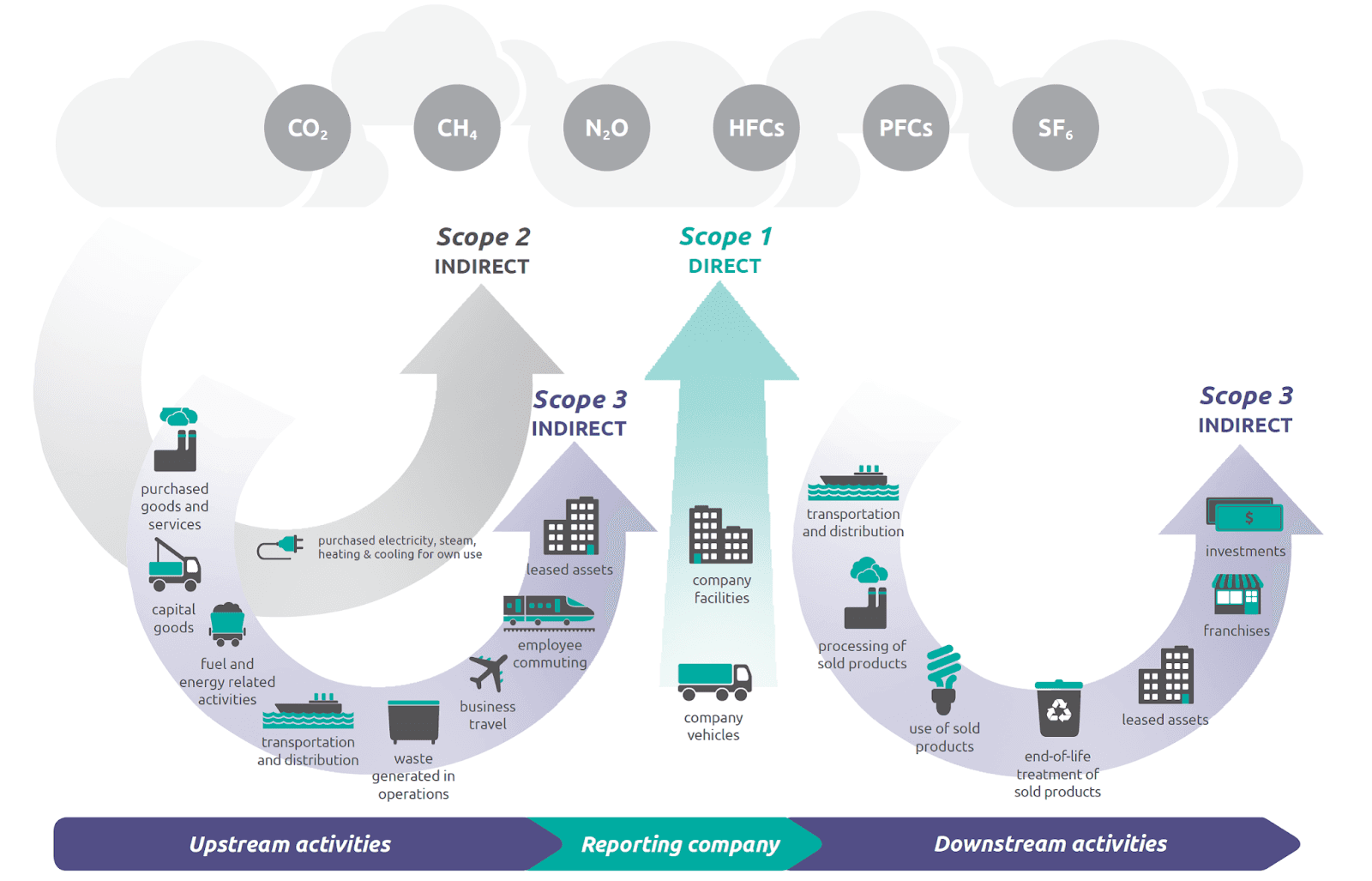
Source: WRI/WBCSD Corporate Value Chain (Scope 3) Accounting and Reporting Standard (PDF), page 5.
Why Are There Three Different Emission Scopes?
The main reason for having three different emission scopes (Scope 1, 2, and 3) is to help companies better understand the sources and responsibilities of their greenhouse gas emissions. These scopes are classified according to where emissions occur and the level of control companies have over these emissions. Thus:
Defining Responsibilities: Helps to understand the difference between emissions that companies can control directly and those they can influence indirectly.
Transparency and Accountability: Ensures that companies report all their emission sources transparently and are accountable for their efforts to reduce emissions.
Risk Management: Helps companies better understand and manage climate change-related risks (physical risks, transition risks).
Developing Reduction Strategies: Enables companies to develop more effective and focused strategies for reducing emissions.
Why Is It Important to Manage Scope 1, 2, and 3 Emissions?
Understanding and managing Scope 1, 2, and 3 emissions is important for companies for many reasons:
Managing Climate Risks: Companies can better understand and manage physical risks associated with climate change (e.g., extreme weather events, floods, droughts) and transition risks (e.g., policy changes, technological advancements, shifts in consumer behavior) by measuring and reducing their emissions.
Regulatory Compliance: Many countries and regions are introducing regulations that require companies to report and reduce their greenhouse gas emissions. Companies that track their emissions can comply with legal requirements and avoid penalties.
Meeting Stakeholder Expectations: Investors, customers, employees, and society are placing greater importance on the sustainability performance of companies. Companies that reduce their emissions can meet stakeholder expectations and strengthen their brand reputation.
Gaining Competitive Advantage: Sustainability has become an important competitive factor for companies. Companies that reduce their emissions and report transparently can stand out in the market and seize new business opportunities.
Providing Cost Savings: Efforts to reduce emissions can help companies enhance their energy efficiency, optimize resource use, and reduce waste production. Such improvements increase operational efficiency and lead to cost savings.
How Can Companies Manage Their Emissions?
Companies can use various strategies and tools to manage their Scope 1, 2, and 3 emissions:
Emission Measurement and Reporting: Accurately measuring and reporting emissions is fundamental to the emission management process. Companies can calculate and report their emissions using international standards such as the greenhouse gas protocol (GHG Protocol).
Setting Targets: Companies can focus their emission management efforts by setting emission reduction targets. The Science Based Targets Initiative (SBTi) provides a framework for companies to set emission reduction targets aligned with the goals of the Paris Agreement.
Emission Reduction Strategies: Companies can implement various strategies to reduce their emissions. These strategies may vary based on the company's industry, size, and activities.
For Scope 1 and 2 Emissions: Increase energy efficiency, switch to renewable energy sources, optimize production processes, use low-emission technologies.
For Scope 3 Emissions: Collaborate with the supply chain, ask suppliers to reduce their emissions, reduce employee business travel, extend product lifetimes, improve waste management.
Technological Solutions: Companies can use various technological tools and platforms to collect, analyze, and report emission data. These tools can help companies manage and reduce their emissions more effectively.
Collaborations: Companies can collaborate with suppliers, customers, industry organizations, and other stakeholders to reduce their emissions. Value chain collaborations can help companies manage their Scope 3 emissions.
Who Is Obligated to Report Carbon Emissions?
The requirement to report carbon emissions may vary depending on the industry in which the business operates, its size, and regulatory requirements. Industries typically obligated to report carbon emissions include:
Energy Production Sector: Facilities that generate electricity and heat from fossil fuels are subject to strict regulations due to high emission intensity.
Manufacturing and Industrial Sector: Companies operating in heavy industries such as cement, steel, chemicals, and automotive have large amounts of direct and indirect emissions.
Logistics and Transportation: Air, sea, and land transportation companies contribute significantly to Scope 1 and Scope 3 emissions due to fuel consumption.
Agriculture and Food Production: The food production, livestock, and agriculture sectors are major sources of potent greenhouse gases such as methane (CH₄) and nitrous oxide (N₂O).
Textiles and Fashion Industry: The production, shipping, and manufacturing processes involved in the supply chain have a large carbon footprint.
Finance and Banking: Banks, investment funds, and insurance companies are required to track the carbon footprint of the companies in their portfolios.
Companies that do not report and reduce their carbon emissions may face serious risks such as carbon taxes, regulatory fines, and reputational damage.
Frequently Asked Questions (FAQs)
What is the basic difference between Scopes 1, 2, and 3 emissions?
Scope 1 refers to emissions arising from sources directly controlled by the company, Scope 2 refers to indirect emissions resulting from the use of purchased energy, and Scope 3 refers to all other indirect emissions in the company's value chain.
What is the GHG Protocol and why is it important?
The GHG Protocol is an internationally accepted framework for companies to calculate, report, and manage their greenhouse gas emissions, ensuring that companies report their emissions consistently, accurately, and transparently.
Which industries are obligated to report carbon emissions?
Industries such as energy production, manufacturing and industrial sector, logistics and transportation, agriculture and food production, finance and banking are obligated to report carbon emissions.
What should be considered when setting emission reduction targets?
When setting emission reduction targets, objectives should be consistent with international standards such as the Science Based Targets Initiative (SBTi) and tailored to the company's sector, size, and activities.
What risks do companies face if they do not report carbon emissions?
Companies that do not report their carbon emissions face risks such as carbon taxes, regulatory penalties, and reputational loss.
Conclusion
Scopes 1, 2, and 3 carbon emissions represent an essential responsibility that companies must undertake in the fight against climate change. Understanding, measuring, and reducing emissions is critical for achieving sustainability goals, managing climate risks, and gaining a competitive advantage.

Aylık Sürdürülebilirlik Bültenimizin ilk sayısı yayında
Life Climate Aylık Sürdürülebilirlik Bülteni'ne hoş geldiniz. Her ay iklim, karbon piyasaları ve sürdürülebilirlik raporlaması alanındaki düzenleyici gelişmeleri sizin için özetliyoruz.
Read More

VCS (Verra) VMR0017 Update: A New Chapter for Renewable Energy Projects as Hydropower Exits and Solar, Wind Return
Under Verra, the ACM0002 (Grid-connected electricity generation from renewable sources) methodology, which is widely used in renewable energy projects, has been updated and replaced with VMR0017.
Read More
Scope Expansion in CBAM and Its Impact on Exporters in Turkiye
In December 2025, the European Commission published the draft regulation extending the Carbon Border Adjustment Mechanism (CBAM) to downstream products and introducing anti-circumvention measures (2025/0419(COD)).
Read More


